Welding inspections help confirm that welded components meet the required standards for quality, safety, and performance before problems become costly.
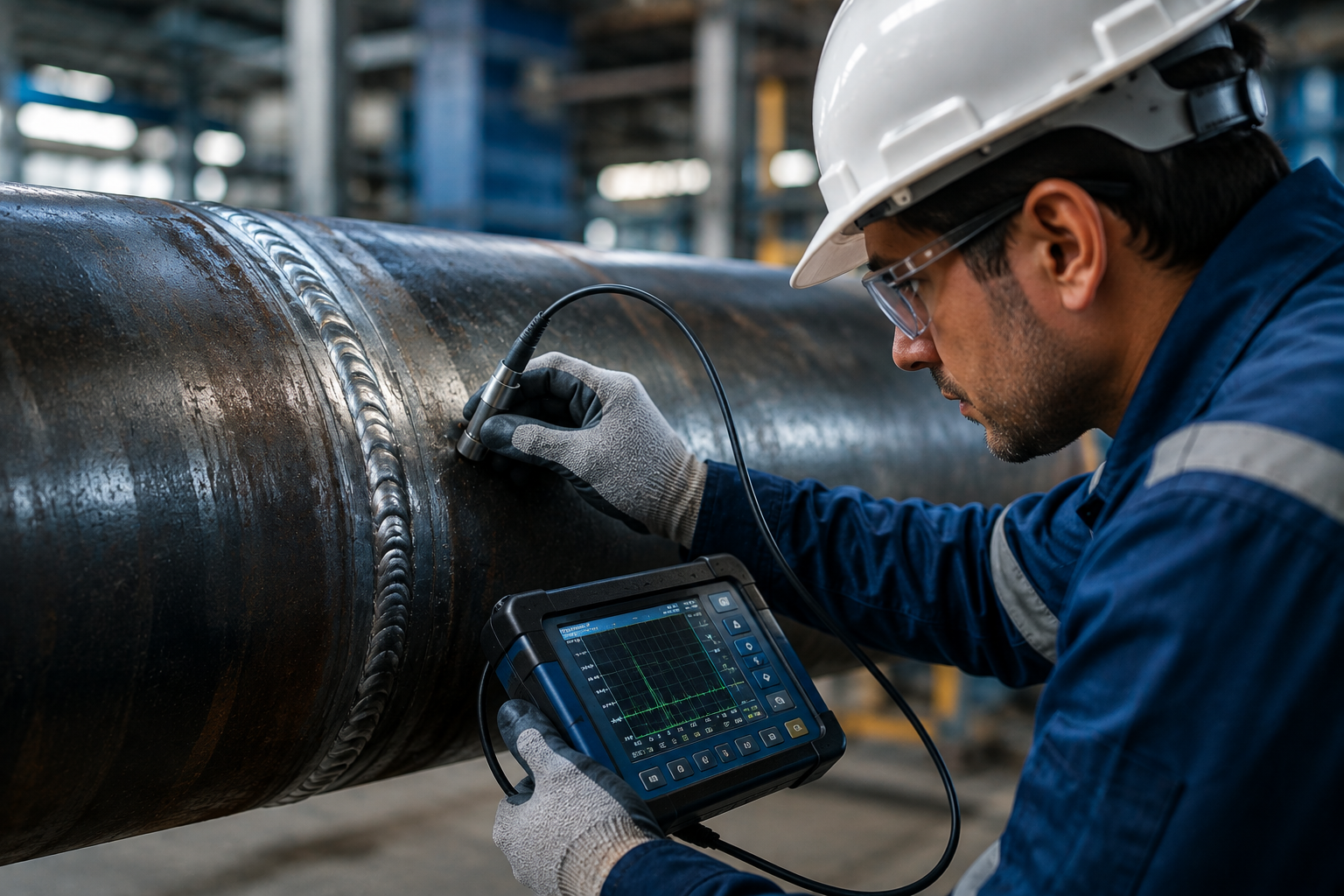
At Gammax Independent Inspection Services Ltd., we provide independent welding inspection and NDT support for fabrication, manufacturing, construction, and specialist engineering projects. We help clients verify weld quality, identify defects early, and confirm compliance with project requirements.
From pre-welding checks through to final reporting, we deliver practical inspection support that maintains weld integrity and reduces rework.
Trusted Welding Inspection Services
Effective weld inspection helps identify issues before they affect performance, delivery schedules, or compliance.
Our inspectors evaluate weld quality, assess workmanship, and confirm compliance with agreed procedures and acceptance criteria.
Clients choose Gammax because we offer:
- Experienced welding inspection specialists
- Support across multiple industries and applications
- Inspection procedures that align with recognised standards
- Clear reporting with practical recommendations
- Access to non-destructive testing services
- Flexible support for one-off and ongoing inspection requirements
What Is Weld Inspection?
Weld inspection is the process of evaluating welded joints to confirm that they meet specified quality, safety, and performance requirements.
Inspectors can carry out welding inspection before welding begins, during production, and after completion. Inspection scope depends on the material, welding method, applicable standards, and the criticality of the finished component.
The purpose of welding inspections is to:
- Verify weld quality and workmanship
- Detect defects before they become larger issues
- Confirm compliance with specifications and standards
- Improve reliability and operational safety
- Reduce repair and maintenance costs
- Provide confidence in completed work
Early inspection helps protect project schedules and long-term performance.
Our Welding Inspection Process
At Gammax, we approach inspections as a complete quality process rather than a single-stage assessment.
Pre-Welding Inspection
Our pre-welding inspection can include:
- Review of approved welding procedures (WPS)
- Material verification
- Joint preparation checks
- Equipment condition assessment
- Welder qualification verification
In-Process Welding Inspection
Monitoring during welding helps identify issues before corrective action becomes costly.
This stage may involve:
- Observing welding methods and application consistency
- Checking key welding parameters remain within specification
- Assessing fit-up and alignment
- Confirming adherence to procedures
- Observing consumable handling and application
Post-Weld Inspection
Following completion, we assess welds against the project and acceptance criteria.
Post-weld inspection may include:
- Visual examination
- Dimensional checks
- Identifying visible defects and assessing acceptance criteria
- Surface condition assessment
- Final inspection reporting
We document findings to support decisions and project traceability.
Welding Inspection Methods Available
Inspection methods depend on material type, weld geometry, accessibility, and applicable standards.
Here are the common methods our professionals use for weld inspection:
Visual Weld Inspection (VT)
Visual inspection is often the first stage of evaluation and forms an essential part of many inspection programmes.
This process can identify visible surface issues, including:
- Cracking
- Undercut
- Inconsistent weld profile
- Surface porosity
- Dimensional concerns
Visual inspection also helps determine whether further testing is required.
Non-Destructive Testing (NDT)
Where projects require additional assessment, we use the following non-destructive testing methods to gain deeper insight without damaging the component:
- Radiographic Testing (RT) – To assess internal weld conditions and identify hidden discontinuities
- Ultrasonic Testing (UT) – To detect internal defects and evaluate weld integrity
- Magnetic Particle Inspection (MPI) – For identifying surface and near-surface defects in ferromagnetic materials
- Dye Penetrant Testing (PT) – To reveal surface-breaking discontinuities
- Positive Material Identification (PMI) – To confirm material composition where projects require verification
We select inspection methods based on component requirements, applicable standards, and project objectives.
Common Weld Defects We Help Identify
Common weld defects that we can help identify through weld inspection include:
Cracking
One of the most critical defects, cracking, can significantly affect structural performance.
Lack of Fusion
Occurs when weld metal does not fully bond with the parent material, reducing joint integrity.
Incomplete Penetration
When the weld does not extend fully through the intended joint thickness.
Porosity
Small gas pockets within the weld that may affect strength and consistency.
Slag Inclusions
Non-metallic material trapped in the weld, which can reduce performance.
Undercut
Grooving along the weld edge that may weaken the finished joint.
Standards and Compliance Support
Many projects require compliance with quality standards, specifications, and regulatory requirements.
We provide practical inspection support throughout project delivery.
Depending on project requirements, our inspection services can support:
- Inspection documentation
- Quality assurance processes
- Project-specific specifications
- Client acceptance criteria
- Documentation and traceability requirements
- BS EN ISO 9606 (welder qualification)
- BS EN ISO 15614 (welding procedure qualification)
- Applicable NDT standards where relevant
Our team provides practical inspection support to help clients maintain confidence in project delivery.
Industries We Support
We support sectors where weld quality, compliance, and reliability are critical, including:
- Fabrication and manufacturing
- Structural steel projects
- Engineering and industrial operations
- Pressure-related applications
- Infrastructure projects
- Specialist production environments
Every project presents different inspection challenges, and we adapt our approach accordingly.
Why Choose Gammax for Welding Inspections?
Choosing the right inspection partner means choosing confidence in your welding quality.
At Gammax, we combine experienced inspection personnel with complementary NDT capabilities to deliver practical inspection services that support compliance, efficiency, and dependable outcomes.
Speak to Gammax About Welding Inspections
Whether you require inspection at a single stage of production or support throughout the welding process, our team can recommend an approach that aligns with your quality requirements, project specifications, and operational timelines.
Contact Gammax to discuss your welding inspection requirements.
Our Services
We test welds so that you don’t have to
- GIIS Ltd, Units 12-13, Oaklands Business Park, Bury St Edmunds, Suffolk, IP33 2RW
- 01284 850 888
- info@gammax.co.uk
FAQ
Most frequent questions and answers
Inspection methods can help identify issues such as cracking, lack of fusion, incomplete penetration, porosity, slag inclusions, and undercut. The detected defects depend on the selected inspection method and whether a surface or internal assessment is required.
There is no single inspection technique that is right for all applications. Visual inspection is typically the first step, with techniques such as radiographic testing, ultrasonic testing, magnetic particle inspection, penetrant testing, and PMI being selected based on the material, weld configuration, and project requirements.
Yes. Welding inspections can support compliance by helping verify that welding activities align with project specifications, applicable standards, and documented acceptance criteria.
Not necessarily. The need for NDT will be dependent on factors such as component criticality, applicable standards, client requirements, and the level of assurance required. Inspection requirements are generally stated as part of the overall quality process.